

Two initiatives linked to cider heritage are moving forward in Astigarraga. On the one hand, carpentry students from three vocational training schools are restoring the cider press of the Erbetegi-Etxeberri farmhouse, a 17th-century piece more than 400 years old. On the other, the mayor, Xabier Urdangarin, announced on 20 November, at the Sagardo Forum technical sessions, that the former Cementos Rezola factory will be refurbished to house heritage related to wood, apples and cider.
Dolareak, a three-way workshop
The restoration of the press is part of Dolareak, a project run by the Peio Martikorena Foundation in collaboration with Astigarraga Town Council and three schools from the New Aquitaine–Euskadi–Navarre Euroregion: CIP Donibane, from Navarre; EASO Politeknikoa, from Gipuzkoa; and the Compagnons centre, from Lapurdi. The Euroregion co-funds it through its 2025 Euroregional Citizenship call. According to the call’s project sheet, the training placement would last fifteen days for twelve students.
The project was presented on 23 October at the municipal warehouse, where the students demonstrated their work live. Urdangarin summed up its aims in three: restoring old cider presses, training young people in traditional carpentry trades and fostering cross-border cooperation through a multilingual programme. “This is the continuation of a journey that began 5 centuries ago, but this is not its last stop,” said the mayor.
The students will clean the wood to assess its condition, apply a protective treatment and learn how a press was put together. Iban de la Fuente, a teacher at Compagnons, pointed out that old wood usually ends up being burnt and that, unlike new wood, “it has to be worked by hand”. Once the press has been assembled, the wood will be dated and a 3D scan will be made for use in teaching materials. The Town Council is looking into where to install the press, which is very large, so that it can be visited.
A double-screw press
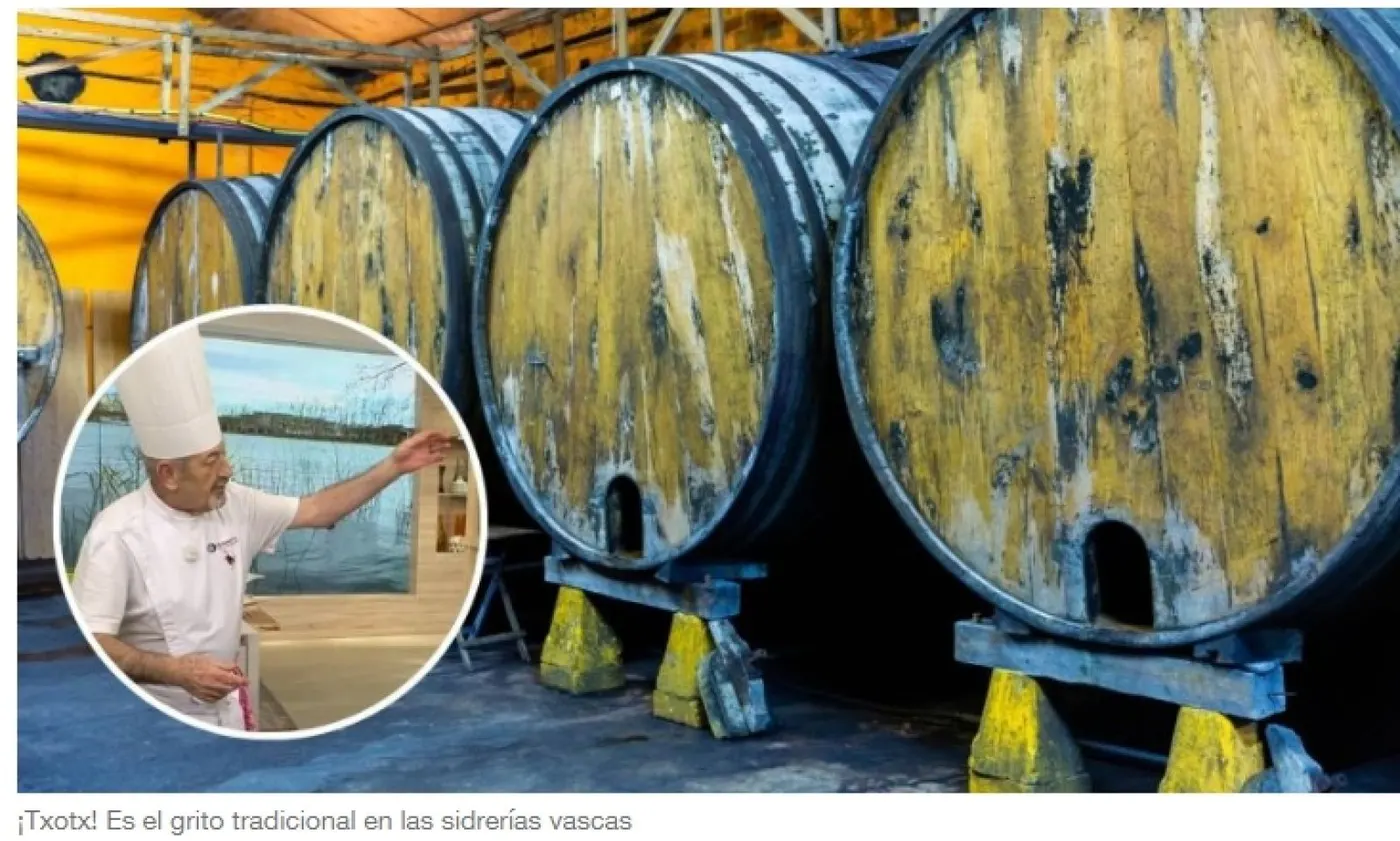
The Erbetegi-Etxeberri farmhouse was divided into two homes, lived in by the Goikoetxea and Izeta families. Its press is the only one known to survive with a double screw and an animal-driven matxaka, the crusher. The press was operated by hand and each screw needed four people. Most of the must was sold in the bars of San Sebastián. Each pressing filled a barrikote (barrel) and, when the cider was ready, the neighbours were called to taste it by playing the txalaparta. The Goikoetxeas were crucial to preserving that instrument: it was with them that Juan Mari Beltran and the brothers Joxean and Jesus Mari Artze learnt to play it.
Rezola, a space for wood and cider
The former cement works still stands on the banks of the Urumea, in the Ergobia district. According to Urdangarin, the refurbishment will be carried out in collaboration with the Peio Martikorena Foundation and the new space will be opened to the public with participatory initiatives. The design will be in the hands of the Navarrese architect Jabier Lekuona, whose studio, Lekuona Arkitektura, renovated the Albaola shipyard in Pasaia, a project that won the 2016 Egurtek Award.
Sources
- Sagardoaren Lurraldea: “Las Jornadas Técnicas del Sagardo Forum pusieron el foco en el patrimonio, la museología, la manzana y la sidra”, 26 November 2025. The organiser’s report: presentation of Dolareak and announcement of the Cementos Rezola refurbishment, location in Ergobia, role of Jabier Lekuona and Albaola.
- Noticias de Gipuzkoa, Asier Oiarbide: “El Sagardo Forum se celebrará del 20 al 22 de noviembre”, 12 November 2025. Programme: the heritage and museology sessions, on 20 November at Erribera.
- Donostitik, E. B. / Redacción: “Estudiantes de carpintería recuperarán un lagar de sidra del siglo XVII en Astigarraga”, 23 October 2025. Presentation of Dolareak: participants, the mayor’s quote, history of the farmhouse, how the press worked and the txalaparta.
- Noticias de Gipuzkoa, Aitziber Muga: “Astigarraga recupera un lagar de más de 400 años”, 23 October 2025. Schools, funding, planned work, dating, 3D scan and search for a location.
- Fundación Peio Martikorena: “Dolareak”. Project page: promoter, partners, co-funding and names of the three schools.
- Estrategia Empresarial: “La Eurorregión financia con 500.000 euros 19 proyectos de ciudadanía eurorregional”, 24 July 2025. Co-funding of Dolareak under the 2025 Euroregional Citizenship call and its project sheet (fifteen days, twelve students).
What do you think?
Log in to your account to like and comment on the news. You also earn achievements.
Choose your username to comment
Your comments are signed with your username. You only choose it once.